bbk gives you one consistent way to pull data from many central bank APIs. Every workflow follows the same two steps, no matter which bank you query:
- Find the identifier of the series (or dataset) you want.
-
Fetch it with the matching
*_data()function.
Step 1: find the identifier
Most central banks organise data into datasets (dataflows), each built on a data structure that defines the dimensions whose codes combine into a series key. bbk lets you explore both from R.
Browse the Bundesbank’s available dataflows:
head(bbk_metadata("dataflow"))
#>        id
#>    <char>
#> 1:  BBAF3
#> 2:  BBAF4
#> 3:  BBAI3
#> 4:  BBAPV
#> 5:  BBASV
#> 6: BBBEK1
#>                                                                           name
#>                                                                         <char>
#> 1:                                  Financial Accounts - internet  time series
#> 2:                                                          Time series ESA 95
#> 3: Deutsche Bundesbank, Statistics on Insurance Corporations and Pension Funds
#> 4:                            Deutsche Bundesbank, Statistics on Pension funds
#> 5: Deutsche Bundesbank, Statistics on Insurance Corporations (Solvency I + II)
#> 6:                                                    AUSTA - Banks in Germany
Take BBEX3, the exchange-rate dataset. It is built on
the BBK_ERX data structure, whose dimensions you can list
with bbk_dimension():
bbk_dimension("BBK_ERX")
#>                          id position               codelist
#>                      <char>    <int>                 <char>
#> 1:             BBK_STD_FREQ        1        CL_BBK_STD_FREQ
#> 2:         BBK_STD_CURRENCY        2    CL_BBK_STD_CURRENCY
#> 3: BBK_ERX_PARTNER_CURRENCY        3    CL_BBK_STD_CURRENCY
#> 4:      BBK_ERX_SERIES_TYPE        4 CL_BBK_ERX_SERIES_TYPE
#> 5:        BBK_ERX_RATE_TYPE        5   CL_BBK_ERX_RATE_TYPE
#> 6:           BBK_ERX_SUFFIX        6      CL_BBK_ERX_SUFFIX
Each dimension supplies one dot-separated part of the key. So a
monthly (M) US dollar (USD) per euro
(EUR) rate, of series type BB, rate type
AC, suffix A01, has the key
M.USD.EUR.BB.AC.A01.
Step 2: fetch the data
Pass the dataflow and key to bbk_data():
usd_eur = bbk_data("BBEX3", key = "M.USD.EUR.BB.AC.A01", start_period = "2015-01-01")
head(usd_eur)
#>          date                       key  value    freq
#>        <Date>                    <char>  <num>  <char>
#> 1: 2015-01-01 BBEX3.M.USD.EUR.BB.AC.A01 1.1305 monthly
#> 2: 2015-02-01 BBEX3.M.USD.EUR.BB.AC.A01 1.1240 monthly
#> 3: 2015-03-01 BBEX3.M.USD.EUR.BB.AC.A01 1.0759 monthly
#> 4: 2015-04-01 BBEX3.M.USD.EUR.BB.AC.A01 1.1215 monthly
#> 5: 2015-05-01 BBEX3.M.USD.EUR.BB.AC.A01 1.0970 monthly
#> 6: 2015-06-01 BBEX3.M.USD.EUR.BB.AC.A01 1.1189 monthly
#>                                                                                               title
#>                                                                                              <char>
#> 1: Euro foreign exchange reference rate of the ECB / EUR 1 = USD ... / United States / End of month
#> 2: Euro foreign exchange reference rate of the ECB / EUR 1 = USD ... / United States / End of month
#> 3: Euro foreign exchange reference rate of the ECB / EUR 1 = USD ... / United States / End of month
#> 4: Euro foreign exchange reference rate of the ECB / EUR 1 = USD ... / United States / End of month
#> 5: Euro foreign exchange reference rate of the ECB / EUR 1 = USD ... / United States / End of month
#> 6: Euro foreign exchange reference rate of the ECB / EUR 1 = USD ... / United States / End of month
#>    currency erx_partner_currency erx_series_type erx_rate_type erx_suffix
#>      <char>               <char>          <char>        <char>     <char>
#> 1:      USD                  EUR              BB            AC        A01
#> 2:      USD                  EUR              BB            AC        A01
#> 3:      USD                  EUR              BB            AC        A01
#> 4:      USD                  EUR              BB            AC        A01
#> 5:      USD                  EUR              BB            AC        A01
#> 6:      USD                  EUR              BB            AC        A01
#>    time_format decimals   unit unit_mult
#>         <char>    <int> <char>    <char>
#> 1:         P1M        4    USD         0
#> 2:         P1M        4    USD         0
#> 3:         P1M        4    USD         0
#> 4:         P1M        4    USD         0
#> 5:         P1M        4    USD         0
#> 6:         P1M        4    USD         0
#>                                                                                                                                                comm_gen
#>                                                                                                                                                  <char>
#> 1: The ECB publishes daily euro foreign exchange reference rates, which are calculated on the basis of the concertation between central banks at 14.15.
#> 2: The ECB publishes daily euro foreign exchange reference rates, which are calculated on the basis of the concertation between central banks at 14.15.
#> 3: The ECB publishes daily euro foreign exchange reference rates, which are calculated on the basis of the concertation between central banks at 14.15.
#> 4: The ECB publishes daily euro foreign exchange reference rates, which are calculated on the basis of the concertation between central banks at 14.15.
#> 5: The ECB publishes daily euro foreign exchange reference rates, which are calculated on the basis of the concertation between central banks at 14.15.
#> 6: The ECB publishes daily euro foreign exchange reference rates, which are calculated on the basis of the concertation between central banks at 14.15.
#>                        comm_src category
#>                          <char>   <char>
#> 1: European Central Bank (ECB).     WEDE
#> 2: European Central Bank (ECB).     WEDE
#> 3: European Central Bank (ECB).     WEDE
#> 4: European Central Bank (ECB).     WEDE
#> 5: European Central Bank (ECB).     WEDE
#> 6: European Central Bank (ECB).     WEDE
If you already know the full identifier, bbk_series()
fetches a single series in one call by prefixing the key with the
dataflow:
bbk_series("BBEX3.M.USD.EUR.BB.AC.A01")Every *_data() function returns a tidy
data.table with a date column and a
value column, ready for analysis or plotting:
library(ggplot2)

ggplot(usd_eur, aes(date, value)) +
  geom_line() +
  theme_minimal() +
  theme(axis.title = element_blank()) +
  labs(title = "US dollar per euro, monthly", subtitle = "Source: Deutsche Bundesbank")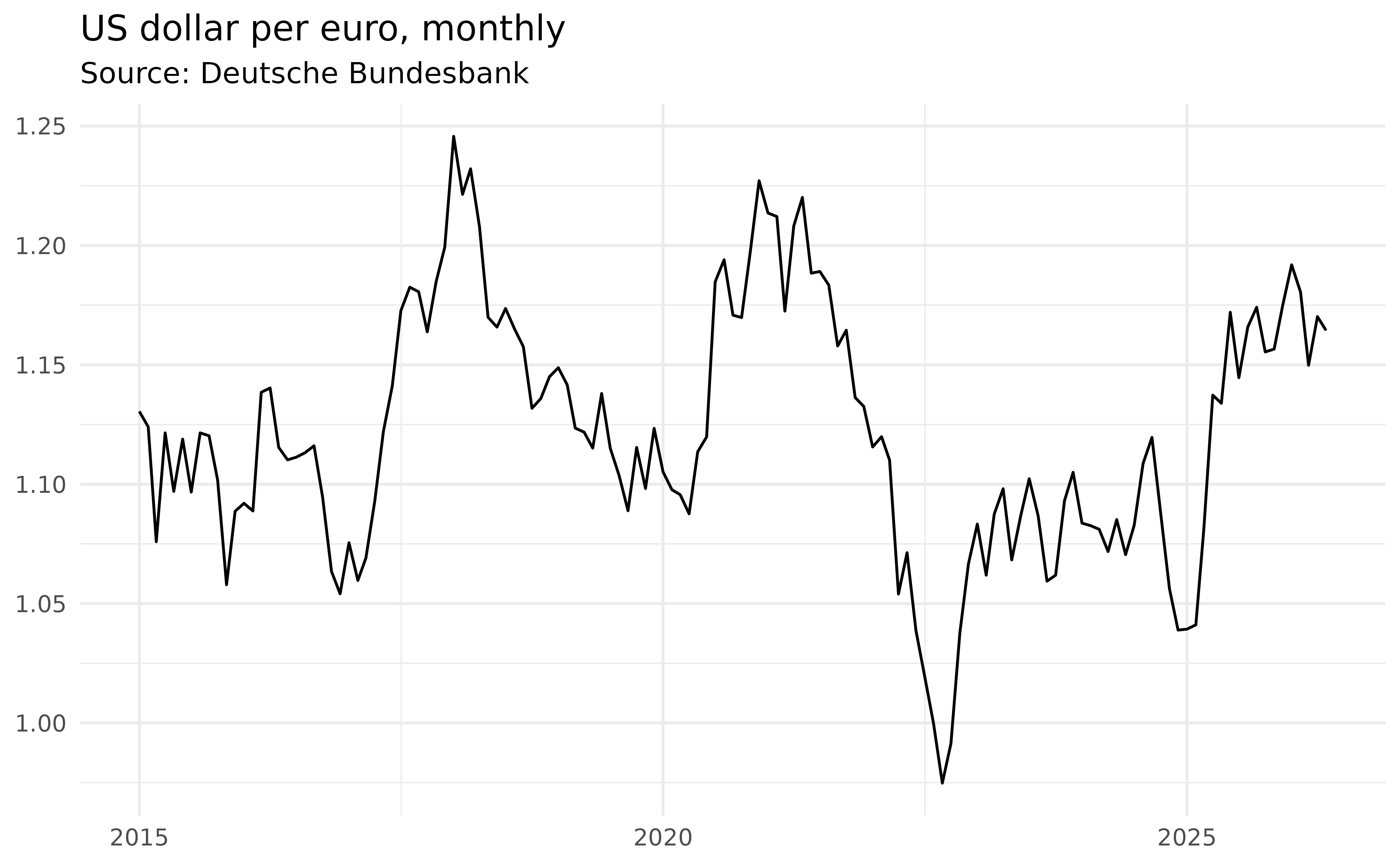
The same two steps work for every supported bank: swap the prefix
(bbk_, ecb_, snb_,
cnb_, …) and use that bank’s discovery and
*_data() functions. See the function reference for what each bank
provides, and Comparing exchange
rates across central banks for a worked example that pulls a
comparable series from several banks at once.
API keys
Most banks require no authentication. The exceptions are Banque de
France (bdf_*) and the Czech National Bank ARAD database
(cnb_data() and friends), which each need a free API key.
Pass it via the api_key argument, or set it once in the
BANQUEDEFRANCE_KEY or CNB_ARAD_KEY environment
variable (e.g. in your .Renviron).
Caching
bbk can cache API responses on disk, so a repeated query can skip downloading data the API allows to be reused. Caching is off by default; enabling it is recommended:
options(bbk.cache = TRUE)Put that line in your .Rprofile to enable caching for
every session. Each API’s caching headers decide whether and for how
long a cached response is reused: where an API allows it, that’s for
minutes rather than hours, and many APIs don’t allow caching at all.
Cached responses older than one day are deleted; change this with
options(bbk.cache_max_age = <seconds>). Inspect or
clear the cache with:
bbk_cache_dir()    # where responses are stored
bbk_cache_clear()  # wipe the cache
Paginated requests, such as boj_data() and
bdp_data(), show a progress bar when they take longer than
a few seconds. Hide it with
options(bbk.progress = FALSE).